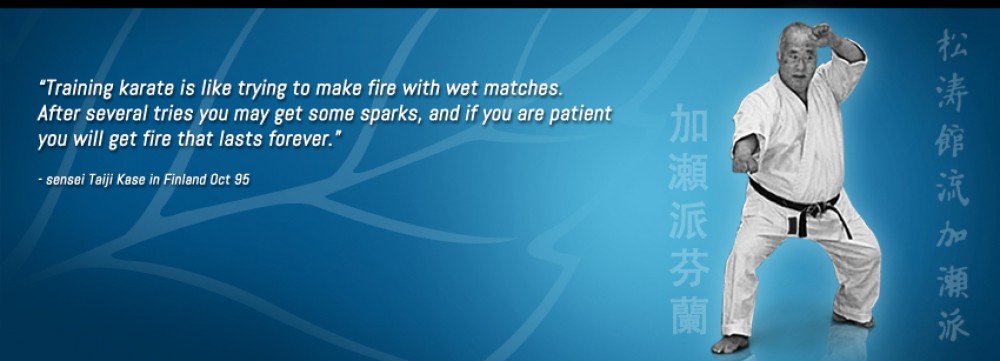
TAIJI KASE
Sensei Taiji Kase was born in 1929. His father was a famous judo
instructor, so it was no wonder that Kase started judo very early in
his life. He gained also second dan grade at this art. When sensei
Kase was 14 years old, he saw a karate demonstration for the first
time. After that nothing could stop him from starting karate
training. Sensei Kase was a student of master Gichin Funakoshi as
well as of his son Yoshitaka Funakoshi, who had a great influence on
sensei Kase.
The Second World War changed the life of everyone in Japan at that
time. Sensei Kase lived also through that time, and he was one of
the pioneers to revive the position of the karate in Japan after the
war. People trained extremely hard. Many gave the training up, but
those who pulled through are a part of the karate history.
Then it was time to start to spread karate to the rest of the world,
also to Europe. Sensei Kase left Japan in 1964. At that time he was
already an established and well-respected instructor of the Japan
Karate Association, the JKA. After a short period spent in Holland
and Belgium he settled down to Paris where he still lives. Because
of his exceptional talent and experience the French Karate
Federation asked him to teach. Fairly soon, however, sensei Kase
left his post in order to continue his own way of teaching Shotokan
karate, free from any sport-political liabilities.
Today sensei Kase is well-known and well-respected all around the
world. This is no wonder, considering that he has dedicated all his
life to following the path he has chosen. He has never done any
other work to live, apart from some small, temporary jobs in order
to survive and to make training possible. Us Europeans have a good
reason to be proud about sensei Kase. Many quarters have tried to
make him return back to Japan. But, sensei Kase has not hesitated in
saying that his place is in Europe, as that is where he built his
career and that is where his students are.
Sensei Kase has shown us just how far you can go with disciplined
and regular karate training. He is always willing to share his
knowledge and experience with those who want to listen. One of his
important pieces of advice goes, as follows: "All karatekas should
practice at least for 20 years before making their mind up whether
to continue or not. Only then all the hard work is starting to bear
fruit. Then you will improve quicker and the training gets easier.
When one reaches this feeling, one is not willing to loose it."
There are not so many masters from sensei Kaseís generation left
anymore. Unfortunately, some of those who still exist, often prove
to be masters of yesterday. Also sensei Kase has had his share of
trouble that one often faces when getting older. In the spring of
1999 he had a heart attack, and he was treated at an intensive care
unit. Only half a year later he was teaching and training again,
technically as superb as ever and mentally stronger than ever. This
is possible only if you live as you teach. "If you teach karate, you
have to practice regularly yourself. You have to practice harder and
more than your students. If you have practised for long enough,
karate is inside you and you can train where ever you are."
This is one point why sensei Kase is still able to develop karate
further. He is not only teaching or repeating the same training
methods as the instructors did in 1960ís or so. Instead of that,
according to his own words, he has taken on from the point where
Yoshitaka Funakoshi finished. Respecting and saving all the main
principles he has developed karate techniques on and on.
Sensei Kase has been to Finland for seven times. All the courses
held have been unforgettable experiences for us. He can be said to
be a truly open-hearted and loyal person whose authority comes from
his example of humanity, integrity and great karate skills.
Sensei Kase has had a distinguished career and without him the world
of karate would have been much poorer. His work will be only fully
appreciated when we will have to manage without his help. |